Beschrijving
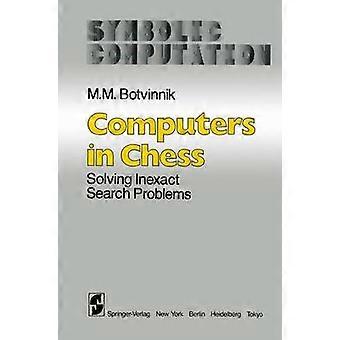
Computers in Chess
1 The General Statement. - Definition of an Inexact Task. - Inexact Tasks and Control Systems. - Two Methods for Solving Inexact Problems. - The Goal of the Game and the Scoring Function. - Goal and Prognosis (The Optimal Variation). - Multi-level Control Systems. - Types of Multi-level Systems. - Advantages of the General Goal. - The Method for Connecting the Optimal Variations of the Components for Types C and E Regimes. - Computer Programs and Humans. - The Expansion of Artifical Intelligence. - 2 Methods for Limiting the Search Tree. - Truncation. - The Goal of an Inexact Game. - The Scoring Function. - Breaking Off a Variation. - The Pruning of Branches. - The Horizon. - Two Trees: The Mathematical Model (MM). - The Stratification of the System. - Three General Limitation Principles. - Improving the Results of a Search. - 3 The Search for a Solution and Historical Experience. - The Search for a Solution by Association. - The Handbook Method of Searching. - 4 An Example of the Solution of an Inexact Problem (Chess). - A. The Search for a Move in an Original Situation. - B. The Use of Historical Experience. - 5 Three Endgame Studies (An Experiment). - 6 The Second World Championship. - KAISSA-CHESS 4. 6. - Conclusions. - Appendix 1. - Fields of Play (by B. M. Stilman). - 1. The Formation of Fields and the Search Within Them. - 1. 1. The Concept of a Field. - 1. 2. The Search Procedure in the Initial Position. - 1. 3. The Formation of Fields During the SearchAn Example. - 1. 4. Formation of a Field. - 1. 5. Storage of Information about Sheaves of Trajectories in Computer Memory. Linked Lists. - 1. 6. Information on the Trajectories of a Field. - 1. 8. Computing the Length of a Denial Trajectory. - 1. 9. Correction of the Sighting Method. - 1. 10. The Pseudosearch. - 1. 11. The Extent of the Climb Up a Branch in thePseudosearch. - 1. 14. Freezing a Trajectory for Lack of a Connection to an Active One. - 1. 15. Criteria for Freezing. - 1. 16. The Algorithm for Freezing. - 1. 18. Trajectory and Field. - 2. The Choice of Moves in an Ensemble of Fields (The Mathematical Model). - 2. 1. The Goal of the Game and the Ending of a Variation. - 2. 2. The Criteria for Breaking Off a Variation in the Search. - 2. 3. Testing the Criteria for Ending a Variation. - 2. 4. Pruning Branches by the Minimax Principle. On the Branch-and-Bound Method. - 2. 5. Pruning Branches by the Worst Case Method. - 2. 6. Priority of Moves in a Search. - 2. 7. Analysis of the Trajectories of a Sheaf for Inclusion in the Search. - 2. 8. Analysis of Trajectories for Forking. - 2. 9. Retreat and Deblockade. - 2. 10. Pruning in the Presence of Branching in a Sheaf of Trajectories. - 2. 11. The Structure of the Search Tree. - 2. 12. A New Content of Known Procedures. - Appendix 2 The Positional Estimate and Assignment of Priorities (by M. A. Tsfasman and B. M. Stilman). - Appendix 3 The Endgame Library in PIONEER (Using Historical Experience by the Handbook Method and the Outreach Method) (by A. D. YUDIN). - 3. 1. Introduction. - 3. 2. Formulation of the Problem. - 3. 3. Configurations. - 3. 4. The Boundary Effect. Decomposition Formulae. - 3. 5. Symmetries. - 3. 6. The Structure of the Library. Classes. Coding of the Information. - 3. 7. Organization of the Information in the Form of Two-Dimensional Tables with Subordination of Entries. - 3. 8. The Algorithm for Using the Endgame Library (The Search for Exact Coincidence). - 3. 9. Examples of the Operation of the Subroutine for Using the Endgame Library. - 3. 10. Outreach for a Library Position. - 3. 11. The Search for Nearby Positions. - 3. 12. Filter with Respect to the Pawn Structure. - 3. 13. The One Color-DifferentColor Filter. - 3. 14. Filters Within a Set of Positions. - 3. 15. Finding a Group of Neighboring Positions. - 3. 16. Implementation of the Outreach Method. Anti-outreach. - 3. 17. Entry from the Move-Search Routine. - 3. 18. Outreach and Exact Coincidence. - 3. 19. The Potential for Wide Use of Library Rules in PIONEER. - 3. 20. The Breakoff Criterion Based on the Rule of the Square. - 3. 21. Conclusion. - Appendix An Associative Library of Fragments (by A. I. Reznitsky and A. D. Yudin). - References. - Glossary of Terms. - Index of Notation. Language: English
-
Fruugo-ID:
337897970-741557341
-
ISBN:
9781461297369
Levering & retouren
Verzonden binnen4 dagen
Verzending vanaf Verenigd Koninkrijk.
We doen ons best om ervoor te zorgen dat de producten die u bestelt volledig en volgens uw specificaties bij u worden afgeleverd. Mocht u echter een onvolledige bestelling ontvangen of andere artikelen dan degene die u heeft besteld, of als er een andere reden is waarom u niet tevreden bent met de bestelling, dan kunt u de bestelling retourneren, of welk product dan ook die bij de bestelling was inbegrepen, en ontvangt u een volledige terugbetaling voor de artikelen. Bekijk het volledige retourbeleid